PRC–Turkmenistan Gas Ties Hedge Hormuz Risk May 11th, 2026
Via Jamestown, a look at China’s efforts to develop overland energy security through Central Asia, especially Turkmenistan:
The People’s Republic of China (PRC) is intensifying its pursuit of overland energy security through Central Asia as the Middle East conflict raises the strategic cost of maritime exposure. Turkmenistan is the primary anchor of this effort. Politburo Standing Committee member Ding Xuexiang’s April 2026 visit to Turkmenistan converted this strategy into a concrete sequence of agreements and implementation mechanisms, including the Galkynysh gas field Phase IV project.
The April visit built on earlier high-level diplomacy that tied Turkmenistan’s political reliability directly to the PRC’s energy security agenda. Xi Jinping’s Diaoyutai Guest House meeting with Gurbanguly Berdimuhamedow framed Turkmenistan’s strategic alignment as including both natural gas cooperation and broader security coordination.
Central Asia is becoming a zone of both PRC–Russia coordination and PRC primacy. Beijing and Moscow share an interest in weakening U.S.-led systems and building alternative Eurasian strategic and economic networks, but in Central Asia Beijing is increasingly the agenda-setter while Russia’s traditional influence is being diluted by war, sanctions, and its diminished status within the authoritarian camp.
Beijing’s energy strategy in Central Asia is increasingly focused on continental hedging. With Turkmenistan as its primary natural gas anchor, overland energy resilience reduces exposure to maritime chokepoints, especially the Strait of Hormuz and other Middle Eastern supply routes exposed to escalating geopolitical conflict (China Brief, March 31). Within this emerging architecture, Central Asia functions as the Eurasian pillar of a broader two-front strategy: Beijing continues to manage maritime energy risks where possible, but it is placing greater strategic weight on land-based suppliers—especially Turkmenistan and Russia—for commodity ballast.
Turkmenistan matters not only as a participant in Middle Corridor connectivity plans, including Trans-Caspian transport coordination, but also as an energy source and PRC–Central Asia gas pipeline node in its own right (Eurasia Daily Monitor, April 28). Its value comes from supporting east–west Eurasian logistics routes that reduce reliance on Russia’s Northern Corridor and from expanding overland gas supplies that can sustain the industrial system of the People’s Republic of China (PRC) during potential maritime disruption, sanctions pressure, or conflict-driven energy volatility (China Brief, May 2).
An important indicator of this strategy came in Politburo Standing Committee member Ding Xuexiang’s (???) April 15–17 visit to Turkmenistan. Beijing elevated the Galkynysh gas field Phase IV project as a state-level priority, signed a new framework agreement on natural gas cooperation, and connected the energy relationship to logistics, technology, and artificial intelligence (AI) (PRC Ministry of Foreign Affairs [MFA], April 18). The visit showed Beijing moving toward a systematic, state-directed expansion of Central Asian energy infrastructure.
Turkmenistan’s Centrality in the PRC’s Continental Gas Strategy
Sending Ding—a Politburo Standing Committee member and the PRC’s lead official on energy security issues, including major energy agreements with Russia—signaled the importance Beijing attaches to the relationship (MFA, September 26, 2025). Ding attended the gas field’s launch alongside People’s Council Chairman Gurbanguly Berdimuhamedow. He said the project would “push bilateral energy cooperation to a higher level” (???????????????????) and emphasized that natural gas cooperation remained “the cornerstone of PRC–Turkmenistan relations” (????????????). Turkmenistan is the PRC’s largest natural-gas partner in Central Asia, but the scale of the relationship remains politically sensitive: Turkmenistan leader Gurbanguly Berdimuhamedow told Chinese state media outlet CGTN that gas shipments to the PRC are roughly 40 bcm annually and should rise toward 65 bcm, though the PRC’s ambassador Ji Shumin (???) reportedly put 2025 exports at 30 bcm days later (Enerpo Journal, December 27, 2023; Eurasianet, March 31). According to PRC readouts, both sides agreed to expand energy cooperation, especially in natural gas, with the PRC side calling for both sides to capitalize on the current “window of cooperation” (?????) (MFA, April 18). Party media’s description of Ding as Xi Jinping’s “special representative” (?????????) further underscored that Beijing attached high priority to the trip.
On April 16, Ding co-chaired the seventh PRC–Turkmenistan Cooperation Committee meeting alongside Rashid Meredov, the deputy prime minister and foreign minister. They signed three documents: the General Agreement on Basic Principles for PRC–Turkmenistan Cooperation in the Natural Gas Field, the PRC–Turkmenistan Government Five-Year Cooperation Plan (2026–2030), and the Minutes of the Seventh Committee Meeting, as well as agreements related to culture, transport and logistics, AI, science and technology, education, and traditional medicine (MFA, April 17).
Ding also opened a Luban Workshop the same day, which he said should become an “important support for upgrading energy cooperation” (?????????????). Luban Workshops are Chinese-sponsored vocational training centers established overseas, primarily under the One Belt One Road (OBOR) initiative, that provide technical skills training, Mandarin language instruction, and academic exchange through partnerships with local educational institutions (Carnegie Politika, October 6, 2025). In Turkmenistan, the workshop has a more targeted energy function: Ding said it would train skilled workers for “oil and gas exploration and development” (??????), directly linking the PRC’s vocational diplomacy to the implementation needs of PRC–Turkmenistan gas cooperation (MFA, April 18). [1][1]The workshop was officially inaugurated on April 16, 2026, as part of the “Long Live Turkmen-Chinese Cooperation” scientific and practical conference…
Ding’s meetings with Chairman Gurbanguly Berdimuhamedow and his son, President Serdar Berdimuhamedow, placed the gas agenda inside a broader political alignment. Ding praised the raising of bilateral ties to “comprehensive strategic partners,” which was achieved in 2023 (MFA, January 6, 2023). As Turkmenistan’s leaders noted, this entails support for the PRC’s sovereign and territorial claims, including over Taiwan. Ding also evinced support for Turkmenistan’s “national independence, sovereignty, and territorial integrity” and its “permanent neutrality policy” (???????????????????????????), while asking for Turkmenistan’s continued support on core interests (MFA, April 18).
The political theater was followed by commercial agreements. The China Petroleum Engineering and Construction Corporation (CPECC) signed a $4.6 billion contract for Galkynysh Phase IV—reportedly the largest regional contract in parent CNPC’s history (Caiwen News, April 24; GoalFore Advisory, April 26). Total Central Asian pipeline capacity could rise to 60 billion cubic meters per year as other new projects came online within the same time period (EastMoney, April 27). Through these agreements, Beijing seeks to expand Turkmen gas production, connect it more deeply to overland pipeline infrastructure, and strengthen Central Asia’s role as a continental hedge against disruption to maritime and Middle Eastern supply routes.
Ding’s visit built on a relatively low-profile round of leader-level diplomacy one month earlier that received limited international attention. On March 18, Xi Jinping met Gurbanguly Berdimuhamedow at Beijing’s Diaoyutai State Guest House. Xi told Berdimuhamedow that no matter how the international situation changes, the PRC would “always support” (????) both Turkmenistan’s sovereign and territorial interests, and its policy of permanent neutrality, as Ding later repeated (Xinhua, March 18). As during Ding’s visit, natural gas cooperation was front and center. Xi called for expanding the scale of cooperation in the sector, framing it in terms of “accelerating alignment” (??????) of the OBOR initiative with Turkmenistan’s “Revival of the Silk Road” strategy. According to the PRC readout, Berdimuhamedow echoed the same priorities (Xinhua, March 18).
Figure 1: Central Asian Gas Pipelines
Turkmenistan is both a participant in Middle Corridor energy connectivity plans and an energy source and critical PRC-Central Asia gas pipeline node. (Source: Enerpo Journal)
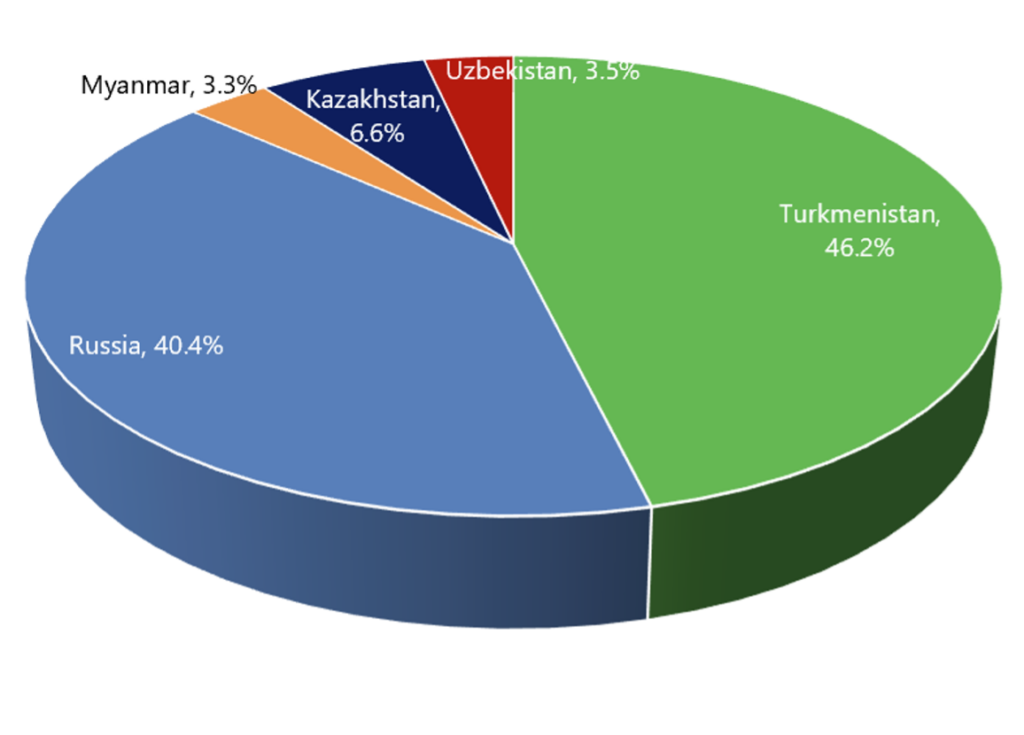
Figure 2: PRC Pipeline Gas Imports by Country in 2024
Pipeline gas is intertwined with the PRC’s strategic “Eurasianist” hedging strategy. (Source: LinkedIn/@Kevin J. Tu)
Central Asia as an Energy Stabilizer in PRC Strategic Thought
Party media and think tank commentary describe Central Asia as critical to the PRC’s energy security strategy in a more volatile international environment. An article shared on the website of policy journal Qiushi stated that the PRC, Russia, and Central Asia are deepening cooperation based on “resource complementarity and strategic mutual trust” (??????????????), and that this cooperation can “offset the adverse impact of geopolitical conflict” (?????????????) in response to a world of “frequent regional conflicts” and persistent “power politics and bullying” (?????????????????) (Guangming Daily, August 30, 2025). The article placed Central Asia inside a wider effort to build a “diversified, low-risk, and sustainable” (???????????) regional energy security system, highlighting consensus reached at the second China–Central Asia Summit in June 2025 on accelerating energy cooperation, promoting natural gas pipeline connectivity, and establishing PRC–Central Asia energy development partnerships.
PRC experts around the June 2025 summit made the same argument in sharper terms. Zhang Ning (??) of the Chinese Academy of Social Sciences (CASS) argued that PRC–Central Asia cooperation “not only promoted the optimization of China’s overseas layout” but also provided Central Asian states with “urgently needed capital and technical support” while “enhancing energy security guarantees” (????????????????????????????????? … ?????????) (Xinhua, June 25, 2025). Kang Jie (??) of the China Institute of International Studies described Central Asia as a region that provides the PRC with energy and minerals “vital to development and energy security” (???????????????) and as an “important forward position” for Chinese goods, companies, technology, and industrial and supply chains to go global (???????????????????????) (Guangming Daily, June 21, 2025).
Kang also linked this explicitly to great power competition. Amid “tariff bullying” (????), “proxy wars” (?????), and rising strategic risks to Central Asia’s west, north, and south, he framed PRC–Central Asia relations as a stabilizing force. Another CASS expert, Sun Zhuangzhi (???), made the same point from a security perspective, arguing that Central Asia had become a “stage of great power geopolitical competition” (???????????) because it possessed economic advantages in “energy, transportation, and markets” (????????) as well as “strategic value that cannot be ignored” (?????????) (Asia-Pacific Security and Maritime Affairs, July 7, 2025).
Within this framework, Turkmenistan occupies a special position. PRC energy industry sources present it as a strategic energy partner whose role is expanding from an overland supplier of gas to a partner in a more diversified energy relationship. A PRC Petroleum News Center article linked Turkmenistan to the next stage of PRC–Central Asia energy security, moving from simple resource extraction toward an “oil and gas plus new energy” (??+???) model (China Petroleum News Center, September 9, 2025). It also argued that the PRC and Central Asia should rely on the PRC–Central Asia gas pipeline, “give full play to the strategic characteristics and international attributes of cross-border pipelines” (???????????????), and “continuously optimize and improve the natural gas transmission network layout” (???????????????). In this understanding, Central Asia is a strategic stabilizer in a conflict-prone world. Turkmenistan is the gas anchor; Kazakhstan and Uzbekistan add energy, minerals, and industrial depth; and the region as a whole supplies the base for the PRC’s overland resilience strategy.
PRC-Led Integration Superseding the SCO
PRC policy in Central Asia is characterized by a drive toward comprehensive institutional integration, expanded security cooperation, and the creation of a PRC-led Eurasian architecture that functions independently of Western financial and trade norms. Beijing is moving to hardwire integration across Eurasia by overlaying the OBOR initiative with regional frameworks like Russia’s Eurasian Economic Union (China Brief, May 14, 2025; March 20). This strategy aims to create connectivity platforms and insulated logistical corridors that reduce dependence on maritime chokepoints and Western oversight. High-level diplomatic efforts, such as the 2023 and 2025 China–Central Asia summits, have underscored the region’s role as a primary pillar for this parallel international order.
Beijing uses the Shanghai Cooperation Organization (SCO) as a primary vehicle for regional security and industrial alignment, but diplomacy at the bilateral level and “PRC-only” multilateralism are displacing the SCO format as Beijing’s preferred modes of regional influence-building. [2][2]This parallels the PRC’s approach to Europe. In comparison with the more process-oriented SCO, the most recent China–Central Asia Summit produced agreements totaling nearly $25 billion with the five Central Asian states, focusing on energy, transport, and mining—sectors where Beijing’s leadership is most pronounced (China Brief, October 17, 2025). As a result, the PRC is now the largest trading partner for all five (BBC Monitoring, February 2). The SCO likely will remain a primary vector for Beijing’s anti-U.S. agenda, but its utility increasingly will be augmented by bilateral channels for more concrete measures—with energy security as a primary example. Beijing recently used the platform to offer PRC-led industrial cooperation and regional security centers in cities such as Tashkent and Dushanbe, further embedding the PRC’s supply chain and security presence in the region (China Brief, March 20).
These dynamics indicate that the PRC’s relationship with Central Asia is becoming increasingly bloc-like in nature. Major regional decisions are more often shaped in Beijing, leaving Russia as a junior partner even in its traditional near abroad. While both the PRC and Russia share a stake in a strategy aimed at outflanking U.S.-led global systems using a broader patchwork of “multipolar” arrangements, Russia has been forced to cede economic and technological influence in Central Asia as relative power within the authoritarian camp has shifted from Moscow to Beijing. This shift has been accelerated by the adoption of more careful balancing by Central Asian states, who aim to reduce traditional dependence on Russia (Asia Policy, January 28).
Conclusion
The PRC’s Central Asian strategy is becoming one of the clearest expressions of its broader effort to prepare for prolonged geopolitical friction. The region gives Beijing access to what it calls “strategic corridors” (????)—overland energy supplies, minerals, transport corridors, industrial partnerships, and security relationships that reduce exposure to maritime disruption and U.S.-controlled chokepoints. Turkmenistan’s political alignment and capacity to provide a reliable source of natural gas—a critical piece in Beijing’s energy security architecture—make it central.
Beyond being a response to U.S.–PRC competition, this emerging Central Asian architecture is reshaping the balance inside the authoritarian camp. The result of this shift, which has been accelerated by Russia’s war in Ukraine, is bloc-like but not equal. Russia’s military and diplomatic capabilities have diminished, and its economic model has become more dependent on commodities, sanctions evasion, and PRC demand. Central Asian states, meanwhile, have increasingly adopted balancing strategies designed to reduce their traditional dependence on Moscow. The PRC offers capital, infrastructure, consumer markets, and industrial technology. That gives Beijing advantages Russia cannot easily match.
This entry was posted on Monday, May 11th, 2026 at 6:08 pm and is filed under China, Turkmenistan. You can follow any responses to this entry through the RSS 2.0 feed.
Both comments and pings are currently closed.
Comments are closed.
ABOUT
Wildcats & Black Sheep is a personal interest blog dedicated to the identification and evaluation of maverick investment opportunities arising in frontier - and, what some may consider to be, “rogue” or “black sheep” - markets around the world.
Focusing primarily on The New Seven Sisters - the largely state owned petroleum companies from the emerging world that have become key players in the oil & gas industry as identified by Carola Hoyos, Chief Energy Correspondent for The Financial Times - but spanning other nascent opportunities around the globe that may hold potential in the years ahead, Wildcats & Black Sheep is a place for the adventurous to contemplate & evaluate the emerging markets of tomorrow.