Taliban Gains Give Investors Cause For Concern Beyond Afghanistan August 15th, 2021
Via Reuters, an article on how Taliban gains give investors cause for concern beyond Afghanistan:
The Taliban’s rapid advance towards Kabul is not only causing concern about Afghanistan’s future but also about the impact on other countries in the region and their economies.
Iran and then Iraq lie to the west of Afghanistan. Tajikistan, Turkmenistan and Uzbekistan are to the north. But the immediate focus for financial markets and investors is Pakistan to the east.
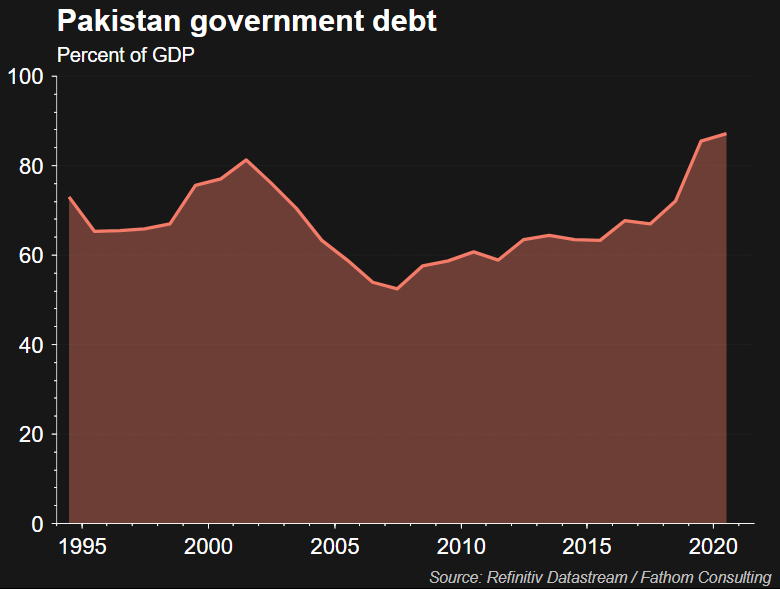
Pakistan has a large public debt, a sizeable equity market (.KSE) and is dependent on a $6-billion IMF programme. The prospect of years of violence and waves of refugees will add pressure to its fiscal repair plans.
“It is a very troubling situation and unfortunately has set the region back many years,” said Shamaila Khan, head of emerging market debt at AllianceBernstein. “I think the neighbouring countries will have to deal with an influx of refugees in the coming months/years”.
The United Nations refugee agency UNHCR estimates 400,000 Afghans have fled their homes this year. Only a few hundred of these displaced persons are known to have fled Afghanistan but the UNHCR estimates there are 2.6 million Afghan refugees worldwide, with 1.4 million in Pakistan and 1 million in Iran.
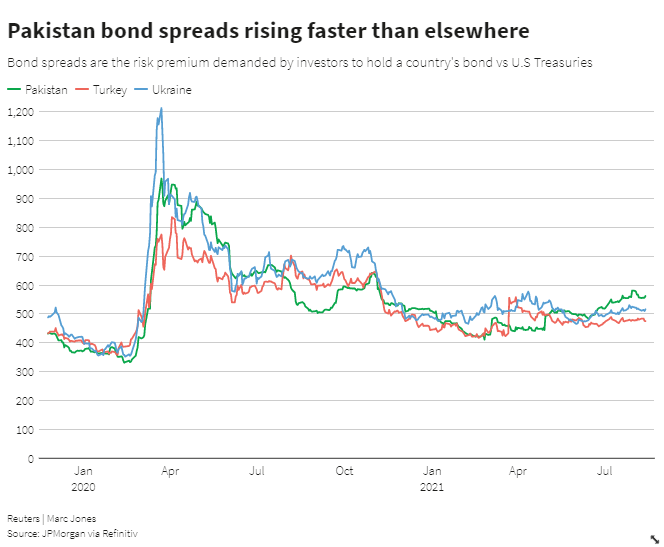
Pakistan’s bond prices have already fallen nearly 8% this year, though many financial analysts think this has probably had more to do with delays in it obtaining its latest tranche of IMF money than with the security situation.
Nearly 10,000 Pakistani civilians were killed in attacks between 2010 and 2015 South Asia Terrorism Portal figures show. Those numbers have fallen since then but there are concerns they will now rise again.
“Another influx of refugees and the spillover of violent groups motivated to destabilise urban areas and infrastructure, particularly, on the western side of Pakistan… could set Pakistan’s recovery and reform story back,” said Hasnain Malik, an analyst at research firm Tellimer.
He suggested risk might be reduced if the Taliban were included in the Afghan government.
Reuters Image
STRATEGICALLY IMPORTANT
Pakistan’s IMF programme is its thirteenth in 30 years and is needed to help the government tackle a public debt of about 90% of GDP.
Any Taliban attacks inside Pakistan could raise security concerns and make it harder for Islamabad to meet targets set by the IMF. At the same time, some investors say, they could increase Pakistan’s strategic important for the West.
“The IMF is carefully watching the fast-moving situation on the ground in Afghanistan,” a Fund spokesperson said on Friday, adding that it was premature to speculate about what impact the security situation could have on Pakistan. read more
“If the Taliban takes control (of Afghanistan), Pakistan becomes even more strategically important to the U.S,” said Kevin Daly, a portfolio manager at ABRDN.
This, he said, could help keep IMF money flowing.
Kay Van-Petersen, a global macro strategist at Saxo Capital Markets in Singapore, said the impact of the crisis in Afghanistan could ultimately spread far wider.
Many Afghan refugees could seek refuge in Europe, he said, following an earlier influx of migrants, mostly fleeing war or persecution in Syria, other Middle Eastern countries and Afghanistan.
If the refugees travel via Turkey, he said, they could help Turkish President Tayyip Erdogan make political or financial demands of the European Union.
“Basically it’s a lever for Erdogan to pull with the European Union …’Pay us to take care of these refugees, or we are just going to let them through’,” he said.
This could weigh on the euro and lift Turkey’s lira , he said.
Emerging market watcher Tim Ash at BlueBay Asset Management said that the Taliban’s advances as NATO troops withdrew had damaged U.S. credibility and fed into the growing rivalry between Washington and China. read more
“Comparisons with Vietnam abound,” Ash said, recalling the evacuation of the last Americans and many South Vietnamese via from the roof of the U.S. embassy as Saigon fell in 1975. “With that feeling of a Saigon moment and the last U.S. helicopter out.”
Reuters Image
This entry was posted on Sunday, August 15th, 2021 at 9:40 am and is filed under Afghanistan, Pakistan. You can follow any responses to this entry through the RSS 2.0 feed.
Both comments and pings are currently closed.
Comments are closed.
ABOUT
Wildcats & Black Sheep is a personal interest blog dedicated to the identification and evaluation of maverick investment opportunities arising in frontier - and, what some may consider to be, “rogue” or “black sheep” - markets around the world.
Focusing primarily on The New Seven Sisters - the largely state owned petroleum companies from the emerging world that have become key players in the oil & gas industry as identified by Carola Hoyos, Chief Energy Correspondent for The Financial Times - but spanning other nascent opportunities around the globe that may hold potential in the years ahead, Wildcats & Black Sheep is a place for the adventurous to contemplate & evaluate the emerging markets of tomorrow.