
December 1st, 2025
Via Bloomberg, a look at how – with shipping outposts on six continents – Beijing has cemented its trade dominance. That some could be used by its navy has other nations worried.
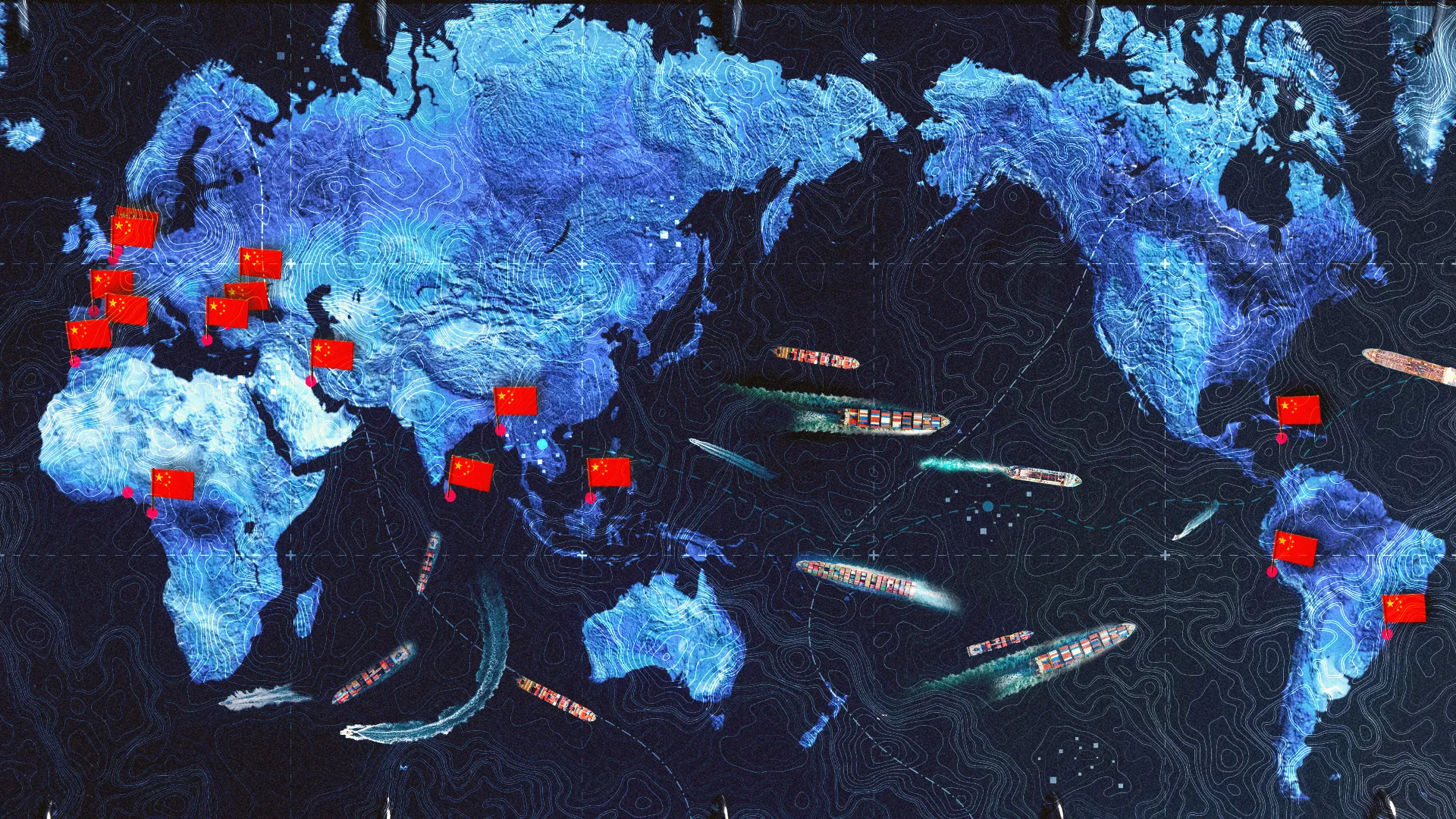
Illustration: Christian Capestany
-
China has invested tens of billions of dollars in building or investing in a global network of commercial ports on every continent save Antarctica.
-
Many of the ports have potential military uses that experts contend could be exploited in a crisis, with at least 14 ports with Chinese majority ownership identified as having such potential.
-
The US and other nations are concerned about China’s influence over the ports, including the potential to impede canal traffic in a time of conflict, with the European Union considering tightening controls on foreign ownership of critical transport infrastructure.
Over the past two decades, China has invested tens of billions of dollars in building or investing in a global network of commercial ports on every continent save Antarctica. Dominating trade infrastructure through shipping, highways and rail is a central pillar of President Xi Jinping’s Belt and Road Initiative, and it’s become a growing strategic advantage amid President Donald Trump’s trade war.
With the US retreating from foreign investment just as China accelerates, these projects have dwarfed similar efforts by any other country. China’s state-owned or affiliated entities reportedly have invested more than $60 billion in 129 overseas port projects. Within this expansion is something the US and other nations consider a disturbing trend: As we explain in this Bloomberg Originals mini-documentary, many of those ports have potential military uses that experts contend could be exploited in a crisis.
Since World War II, the US has maintained a constellation of military bases across the globe. But as America steps back from the international stage amid a focus on domestic politics and growing internal instability, China is moving to fill the gap. At least 14 ports with Chinese majority ownership have been identified as having potential military uses, a development that has som countries rethinking earlier agreements. In Australia for example, the government said it plans to reclaim the port of Darwin from its Chinese leaseholder. And the European Union is considering tightening controls on foreign ownership of what it calls “critical transport infrastructure.”
For Trump, the more immediate concern is how China could leverage the ports it controls as part of trade tensions. The Republican president has expressed particular concern about Beijing’s influence over the Panama Canal, which US President Jimmy Carter long ago returned to Panama. Two ports on either side of the canal are owned by Hong Kong-based conglomerate CK Hutchison. Trump aides have claimed that control of these ports by Chinese companies could allow Beijing to impede canal traffic in a time of conflict, trade or otherwise. This could be a major threat to the US economy, since 40% of the country’s container traffic passes through the canal.
In this documentary, we explore these risks for the US and other nations, while also showing how many of the countries where China is building or investing in ports have welcomed the attention and money.
Focusing primarily on The New Seven Sisters - the largely state owned petroleum companies from the emerging world that have become key players in the oil & gas industry as identified by Carola Hoyos, Chief Energy Correspondent for The Financial Times - but spanning other nascent opportunities around the globe that may hold potential in the years ahead, Wildcats & Black Sheep is a place for the adventurous to contemplate & evaluate the emerging markets of tomorrow.