How Trump Could Take Control of DRC’s Rubaya Coltan Mine from AFC/M23 Rebels March 6th, 2026
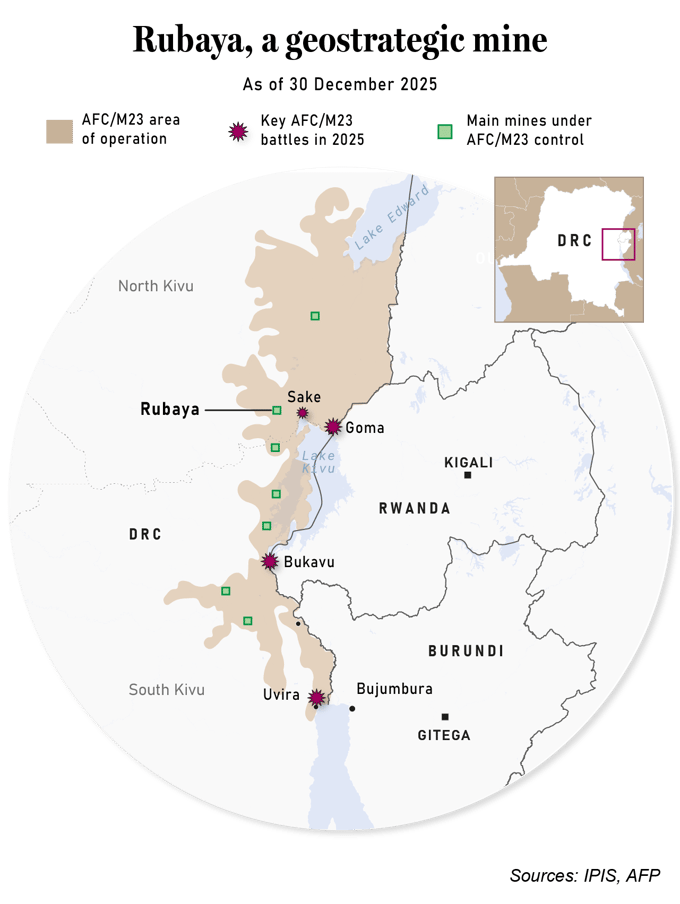
Via The Africa Report, a look at Rubaya – a project that has been officially added to the list of strategic mining assets that Kinshasa is offering to the United States. Highly coveted, the site remains under de facto rebel control and is under constant attack. Here is an analysis in infographics.
On 24 February, Willy Ngoma, the military spokesperson for the Alliance Fleuve Congo (AFC)/M23, was killed by a drone strike in the Democratic Republic of Congo’s Masisi territory, just kilometres from Rubaya, while fighting raged around this strategic mining town in North Kivu. Weeks earlier, on 28–29 January, two landslides had killed at least 200 artisanal miners.
In just a few weeks, these two events brought renewed attention to the situation at the world’s largest coltan mine: the harsh working conditions for miners in a war where critical minerals are both a stake and, in many ways, a driving force. And they come as the Donald Trump administration – which has made access to Congolese minerals a condition for its involvement in negotiations between DRC and Rwanda – is moving decisively to secure its interests.
On 5 February, during a meeting held in Washington, Kinshasa officially presented the US with an initial list of 25 priority mining assets that could fall under American companies, according to Reuters. The Rubaya site is on that list, the Congolese deputy prime minister Daniel Mukoko Samba confirmed to us in an interview a few days after the meeting.
“I should specify that this is a starting point, not a final list, and that new sites or assets could be added,” Mukoko Samba said. Regarding Rubaya, he acknowledged that it “is currently beyond the government’s control”, but rejected criticism from those worried that Kinshasa might sell strategic sites cheaply.
“The only real sell-off is of our raw materials when they leave the territory illegally, as is the case with Rubaya coltan. This must stop,” he said.
Gentry Beach and Donald Trump: suspicions of conflict of interest
Under the agreement between Kinshasa and Washington, American companies will have a right of first offer on these assets. Entrepreneurs close to President Trump have already expressed interest, in particular Gentry Beach, CEO of the investment fund America First Global, who is part of a consortium that began negotiations even before the Washington agreement was signed by Félix Tshisekedi and Paul Kagame on 27 June at the White House.
The Texan businessman played a central role in Trump’s 2016 campaign team, where he served as vice-president in charge of finances. The ‘deal’ he proposed to Kinshasa envisages majority control, with the Congolese state retaining 30% of the shares, according to Reuters.
More than 50 Democratic lawmakers have expressed concern about Beach’s ambitions regarding Congolese mining resources. Last August, when the Financial Times revealed the first negotiations on Rubaya, Californian Democrat Rep. Linda Sanchez questioned Trump about an “apparent conflict of interest in the negotiations between this administration and DRC”.
Concerned about Beach’s role – “one of your political associates” – the lawmaker requested, “given the seriousness of the stakes”, the establishment of a transparent process. “Strategic minerals cannot be exploited at the expense of the health, land, and future of the Congolese people,” she said.
Two Swiss actors are also involved: the trader Mercuria and the investment fund TechMet. Mercuria – already a partner of the Congolese state mining company Gécamines in copper extraction – reportedly made a proposal to modernise the Rubaya site.
How Rubaya coltan finances the M23
By taking control of Rubaya on 30 April 2024, the AFC/M23 seized one of the richest coltan deposits in the world, whose production represents 15% of global supply and half of Congolese exports. The mineral, from which tantalum is extracted, is used to manufacture capacitors found in almost all smartphones and computers, as well as in aerospace components and gas turbines.
For Washington, seeking to counter China’s dominance over critical minerals, Rubaya is extremely valuable. Kinshasa estimates that between $50m and $150m would be needed to revive and industrialise the site.
Since its takeover, the rebel group has collected “at least $800,000 per month” by imposing taxes on miners and traders, according to the UN Group of Experts on DRC. The precious metal is then partially exported to Rwanda, where it is mixed with domestic production, constituting, according to UN experts, “the largest contamination ever recorded in mineral supply chains in the Great Lakes region”. Kagame disputes these claims.
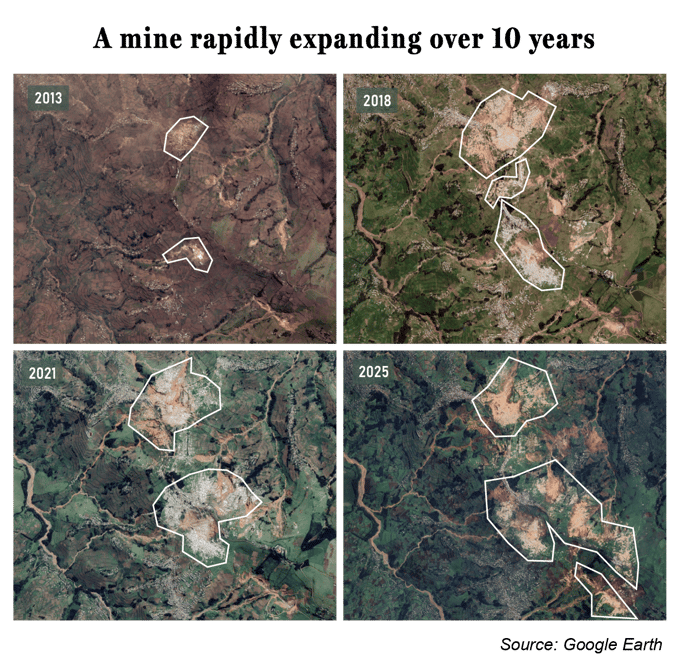
Since 2010, the transformation has been striking. Where satellite images once showed only scattered craters, the land is now ripped open, reflecting extraction that has intensified over 15 years.
Rubaya – the world capital of ‘blood coltan’
This pillaging predates the M23. Rubaya’s history spectacularly illustrates the flaws in traceability mechanisms, particularly ITSCI, a system intended to guarantee that minerals were not extracted amid violence, but which instead allowed large quantities of “blood coltan” to be laundered, according to NGO Global Witness.
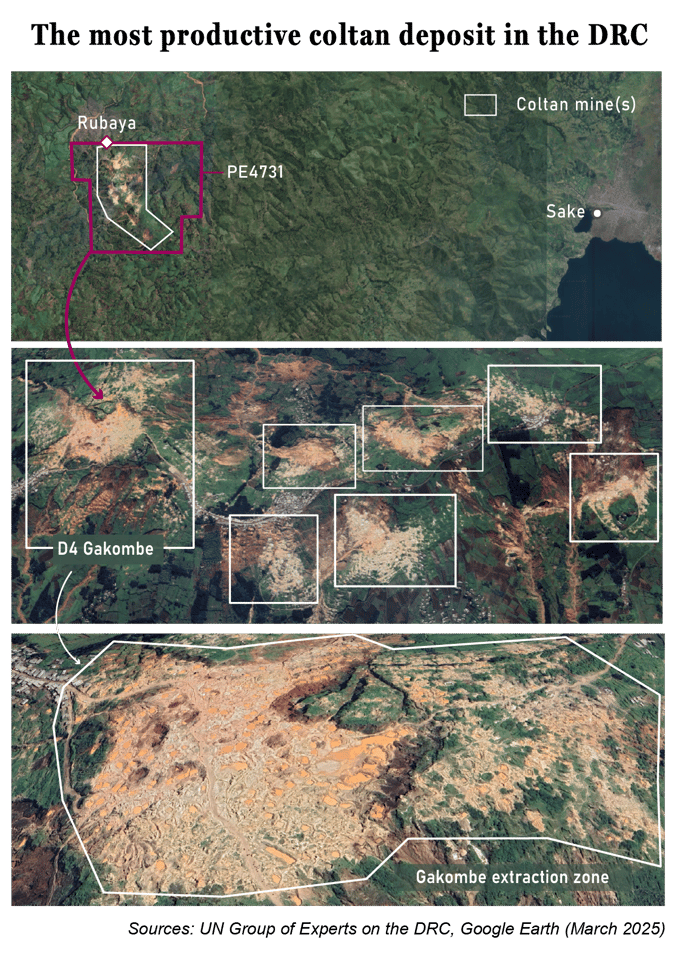
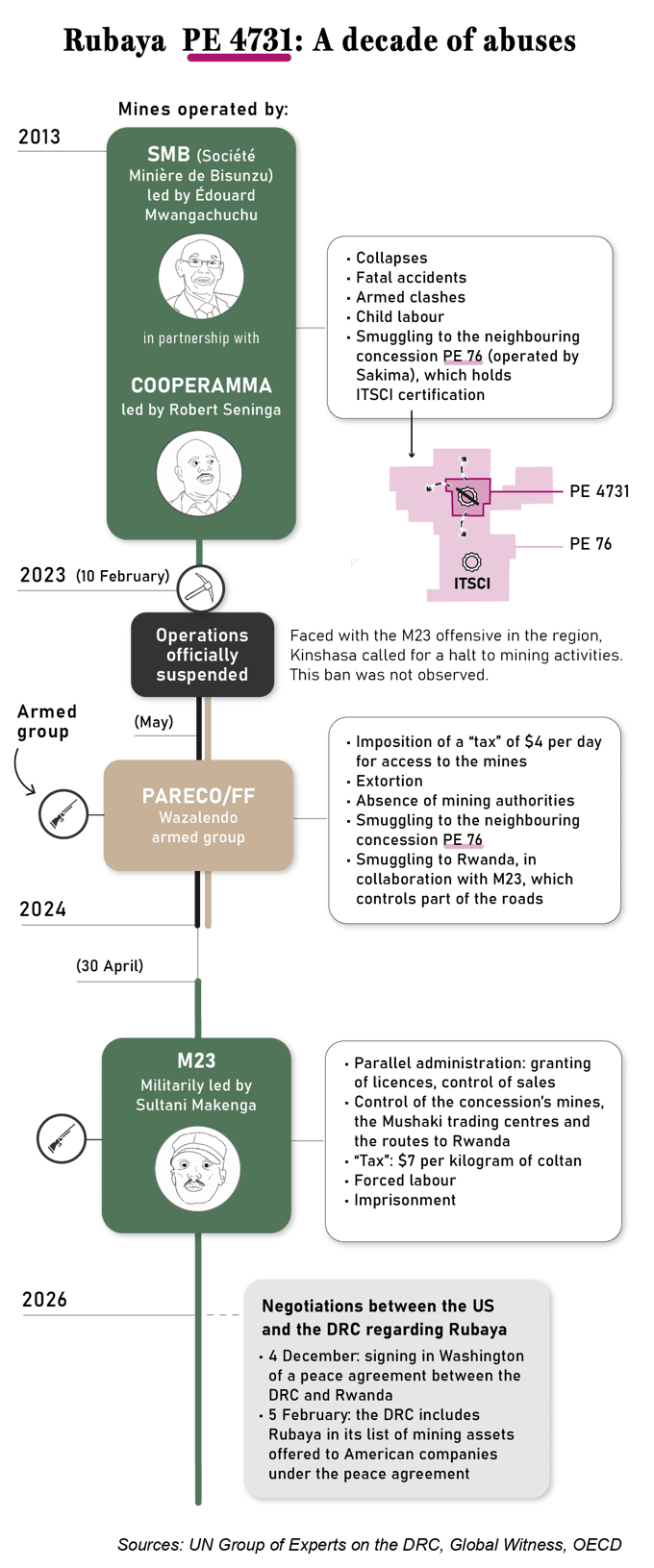
Most coltan from North Kivu comes from a single concession, PE 4731, embedded within the larger PE 76. Historically attributed to the Société Minière de Bisunzu (SMB) of Senator Édouard Mwangachuchu Hizi, it authorised the local cooperative Cooperamma to exploit the mines from 2013.
That same year, a mine collapse killed about 100 people, a warning of the disaster that struck in January 2026. Relations between SMB and the miners deteriorated. In 2018, the company left the ITSCI system, triggering blockages and armed clashes. Production statistics for PE 4731 collapsed, while those of neighbouring PE 76 suspiciously surged – a mineral laundering system denounced by Global Witness.
At the start of 2023, the government ordered a halt to activities. Mwangachuchu was arrested for ‘treason’ (suspected of supporting the M23) and later sentenced to life imprisonment.
Congolese coltan exported to Rwanda
Mining never truly stopped. PARECO-FF, a Wazalendo group allied with the DRC’s armed forces, took over for a year, before the AFC/M23 seized the site. Washington sanctioned PARECO-FF in August 2025 for its role in the pillage, without targeting the M23, already under US sanctions since 2013, whose diplomatic sidelining could have weakened ongoing peace talks.
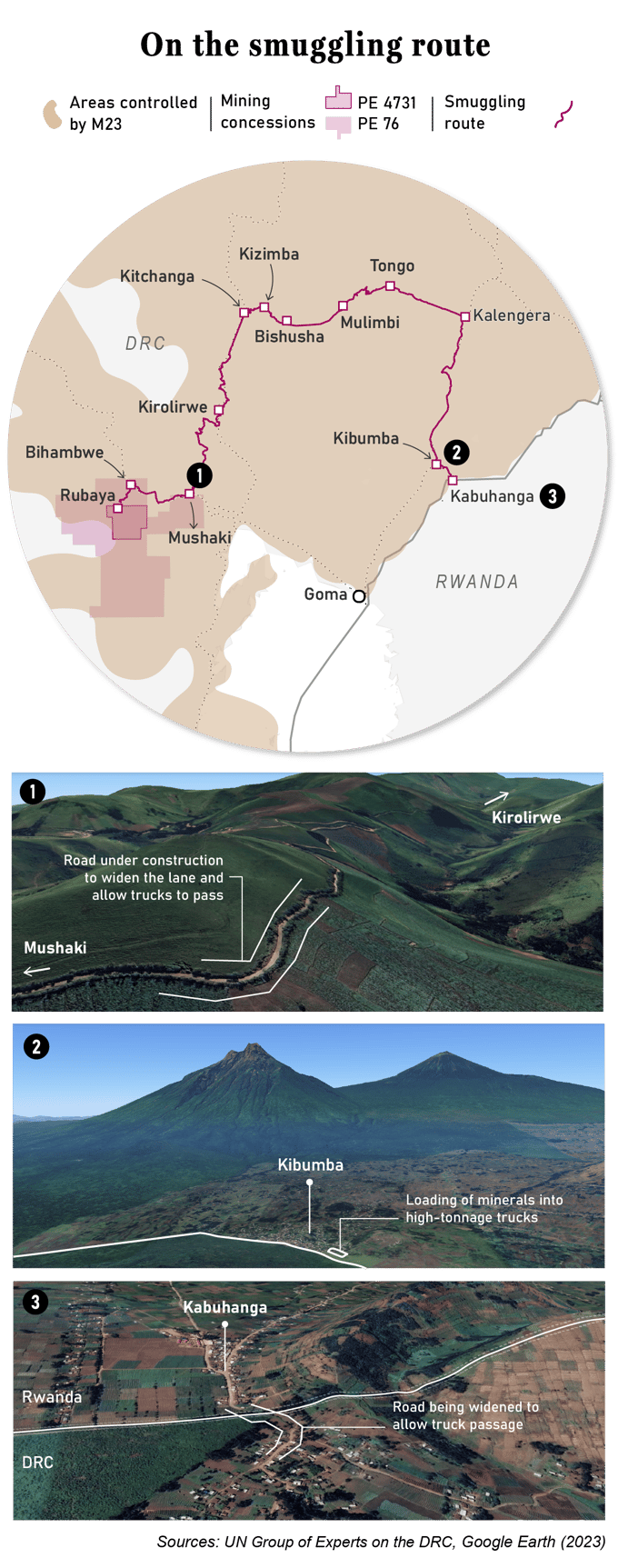
Since taking control, the M23 has established a parallel administration: a ‘ministry’ issues digging permits, wages have been doubled to retain workers, and patrols ensure minerals are sold only to ‘authorised’ operators. Offenders are detained in Mushaki.
Convoys of four to five vehicles made two weekly rotations to the Rwandan border, with cargo transferred at Kibumba into larger trucks from Rwanda. The AFC/M23 imposed the ‘salongo’ – forced labour in Lingala – on local populations to widen transport routes.
By offering Rubaya to Washington while controlling none of it, Kinshasa is playing a risky but calculated card: forcing the US to become involved in retaking the site.
“To advance American investments, the link between armed groups and illegal extraction must be cut,” said Mukoko Samba. The Rubaya mine, at the intersection of American ambitions, Rwandan interests and the Congolese war, is likely far from finished making headlines.
This entry was posted on Friday, March 6th, 2026 at 6:00 am and is filed under Democratic Republic of Congo. You can follow any responses to this entry through the RSS 2.0 feed.
Both comments and pings are currently closed.
Comments are closed.
ABOUT
Wildcats & Black Sheep is a personal interest blog dedicated to the identification and evaluation of maverick investment opportunities arising in frontier - and, what some may consider to be, “rogue” or “black sheep” - markets around the world.
Focusing primarily on The New Seven Sisters - the largely state owned petroleum companies from the emerging world that have become key players in the oil & gas industry as identified by Carola Hoyos, Chief Energy Correspondent for The Financial Times - but spanning other nascent opportunities around the globe that may hold potential in the years ahead, Wildcats & Black Sheep is a place for the adventurous to contemplate & evaluate the emerging markets of tomorrow.