Project Vault to Lobito Corridor: Inside Trump’s Deals to Secure Africa’s Critical Minerals April 20th, 2026
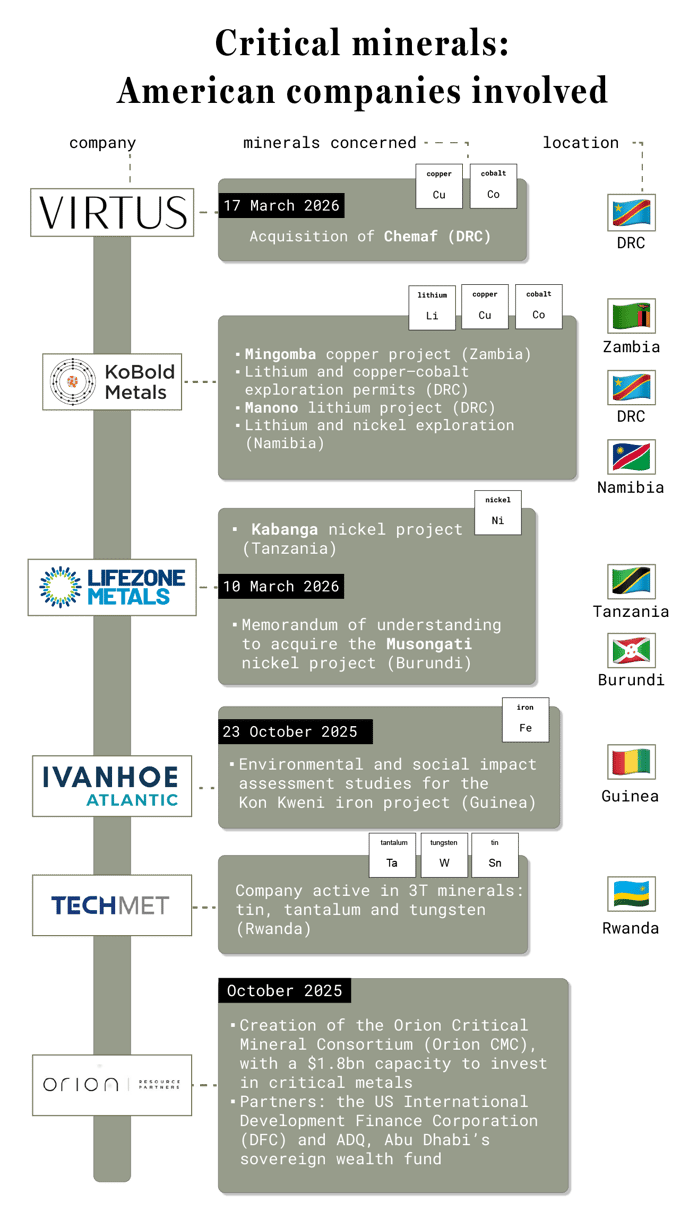
Via The Africa Report, a look at the race for strategic minerals is intensifying, particularly in DRC and Central Africa’s Copperbelt. Trump’s strategy seeks to curb US reliance on Chinese supplies – as this infographic analysis explains:
Direct and aggressive – the strategy deployed by the Donald Trump administration to secure US access to critical minerals reflects the president’s punchy style. Since he came back for a second term as President of the United States in January 2025, the American billionaire has ramped up measures in favour of major US mining companies, from Ivanhoe Atlantic to Virtus Minerals and KoBold Metals.
This policy aligns with Trump’s stated ambition to concede nothing to China in the global race for strategic minerals, particularly in Africa. “We are seeing an acceleration, both in the number of projects and in the scale of the financing deployed,” says Thibault Michel, a critical minerals specialist and researcher at the French think tank the Institut Français des Relations Internationales.
The mining dimension of the Washington agreement
Among the most striking examples is the deal concluded in Washington on 4 December last year between Congolese President Félix Tshisekedi and Rwandan President Paul Kagame, under the auspices of President Trump. On the security front, the ‘great miracle’ promised at the time by the US president, who cast himself as a peacemaker in eastern DRC, has been slow to materialise: fighting between the Congolese armed forces and Alliance Fleuve Congo (AFC)/M23 rebels and their Rwandan allies has never ceased.
The mining side of the deal, sealed between the US and the DRC – through which Trump claimed that “everyone will make a lot of money” – appears, in contrast, to be progressing quickly. On 5 February, DRC submitted a list of priority mining assets open to US investment under the “strategic co-operation mechanism on critical minerals” included in the Washington agreement. Among them is the Rubaya mine, the world’s leading coltan extraction site, still in the hands of AFC/M23 rebels.
This agreement is “the most powerful tool available to the US: it provides privileged access to the Congolese mining sector through strategic projects managed by a joint Congolese–American committee”, says Michel. “US influence is greatly amplified here.”
Central Africa’s Copperbelt in Trump’s sights
This push into Congolese minerals forms part of a broader policy. The US is notably backing the Lobito Corridor refurbishment project, which also includes an 800-kilometre extension of the railway line that is ultimately intended to link the Angolan port’s mineral terminal to the border with DRC.
The stakes are crucial for the United States: the aim is to facilitate supplies of minerals – copper, coltan, manganese, zinc and lithium – to American companies by connecting Central Africa’s Copperbelt to the Atlantic Ocean. The project, vast in scale, brings together more than $10bn in international public and private commitments.
The operating concession has been awarded to Lobito Atlantic Railway, a consortium formed in 2021 bringing together Trafigura (49.5%), Mota-Engil (49.5%) and Vecturis (1%). On 17 December last year, the US Development Finance Corporation (DFC) granted a $553m loan to Lobito Atlantic Railway. To this package – approved under the Biden administration – must be added a further $200m in financing from the Development Bank of Southern Africa.
US increasingly dependent on copper
“Global demand for copper is rising, particularly in the context of the energy transition and digital development, and the US is becoming increasingly dependent on external supplies of this metal,” says Michel. A sign of this concern: last October, the Trump administration added copper to the list of critical minerals whose supply is subject to risks of “serious disruption”.
Project Vault: $12bn for the battle over critical minerals
The latest addition to Washington’s arsenal to counter China’s dominance in the critical minerals sector – Beijing controls around 70% of global production – is Project Vault, a programme launched in early February with a budget of nearly $12bn.
The Export–Import Bank of the United States (Eximbank) has granted a $10bn loan, while $1.67bn will be provided by private capital. This unprecedented level of funding alone accounts for nearly a third of all US investment in critical minerals projects between 2021 and 2026.
As agreements multiply in DRC and beyond, private initiatives are also expanding across the continent. In mid-January, Gécamines exercised its buy-back right over 100,000 tonnes of copper produced by Tenke Fungurume Mining – around 20% of the Congolese company’s total output – specifically destined for the US market.
In early February, a $9bn memorandum of understanding was signed between Glencore and the Orion Critical Minerals Consortium (Orion CMC). Backed by Washington, the deal provides for Orion CMC to acquire a 40% stake in Glencore’s assets in DRC, ultimately taking control of Mutanda Mining and Kamoto Copper Company.
More recently, in March, the US company Sovereign Metals announced the signing of a memorandum of understanding with Japan’s Mitsui for the purchase of 70,000 tonnes per year of rutile extracted from the future Kasiya mine in Malawi.
President Trump has called for the mobilisation of his administration. The secretary of commerce, as well as any other senior executive branch official, must jointly pursue negotiations on agreements “to address the threatened impairment of national security with respect to imports of processed critical minerals and their derivative products from any country”, the White House has instructed.
This entry was posted on Monday, April 20th, 2026 at 9:16 pm and is filed under Uncategorized. You can follow any responses to this entry through the RSS 2.0 feed.
Both comments and pings are currently closed.
Comments are closed.
ABOUT
Wildcats & Black Sheep is a personal interest blog dedicated to the identification and evaluation of maverick investment opportunities arising in frontier - and, what some may consider to be, “rogue” or “black sheep” - markets around the world.
Focusing primarily on The New Seven Sisters - the largely state owned petroleum companies from the emerging world that have become key players in the oil & gas industry as identified by Carola Hoyos, Chief Energy Correspondent for The Financial Times - but spanning other nascent opportunities around the globe that may hold potential in the years ahead, Wildcats & Black Sheep is a place for the adventurous to contemplate & evaluate the emerging markets of tomorrow.