
May 4th, 2023
Courtesy of The Africa Report, a detailed look at the role Africa will play in the minerals of tomorrow:
The green energy resource has once again thrown Africa into the middle of a global resource race. Will the continent get its fair share this time?
The rich veins of Zambia’s north-western copper belt have long epitomised the unfulfilled promise of Africa’s vast mineral wealth.
At independence in 1964, the land-locked nation boasted one of the highest per capita incomes in Africa thanks to the global post-war construction boom. Yet rather than shared prosperity, the voracious appetite for the reddish-brown metal used in buildings, cars and telephone cables fuelled inefficiency and graft.
By the early 1990s, Zambia had become a cautionary tale that helped inspire British economist Richard Auty’s famous theory of the “resource curse.”
Today Zambia – like many countries across the continent – stands on the cusp of another potential payday thanks to the green energy transition.
Africa’s second-largest copper producer seeks to join its Congolese neighbour as a major source of cobalt, a by-product of copper and nickel mining used in the lithium-ion batteries that power many electric vehicles. President Hakainde Hichilema has announced plans to increase production from around 850,000 tonnes a year to 3m tonnes annually by 2032.
“The global transition towards green energy and rapid decarbonisation holds significant opportunities for Africa at large,” Hichilema said at the DRC-Africa Business Forum back in November 2021. “We must seize this opportunity as a continent.”
This rekindled interest in the riches of the earth by business and political leaders is tempered by painful memories and present-day abuses borne of centuries of exploitation dating back to colonial times. Pope Francis spoke to millions across Africa when he denounced the “economic colonialism” that continues to plague natural resource extraction on the continent during his trip to the DRC.
“Hands off the Democratic Republic of the Congo, hands off Africa,” the pope intoned in his 31 January speech at the presidential palace in Kinshasa. “It is not a mine to be stripped or a terrain to be plundered.”
These duelling visions are at the heart of the ongoing debate over the future of mining in Africa.
From Elon Musk pitching lithium mining in Nigeria to the intensifying rivalry between the US and China in the eastern Congo, the battle for control over the resources that will fuel the next energy revolution is now raging across the continent.
The jury is still out on whether, this time, Africa will be able to win its fair share.
High demand
The International Energy Agency (IEA) put the high stakes of today’s global resource race in stark relief when it published its flagship report on “The Role of Critical Minerals in Clean Energy Transitions” back in May 2021.The most comprehensive global study to date on the vital importance of strategic minerals and rare earths found that the average electric vehicle (EV) requires six times the input in minerals needed to build a conventional car. Green power is also a major consumer, with offshore wind generation requiring nine times more mineral inputs than a gas-fired power plant for every megawatt of electricity produced.
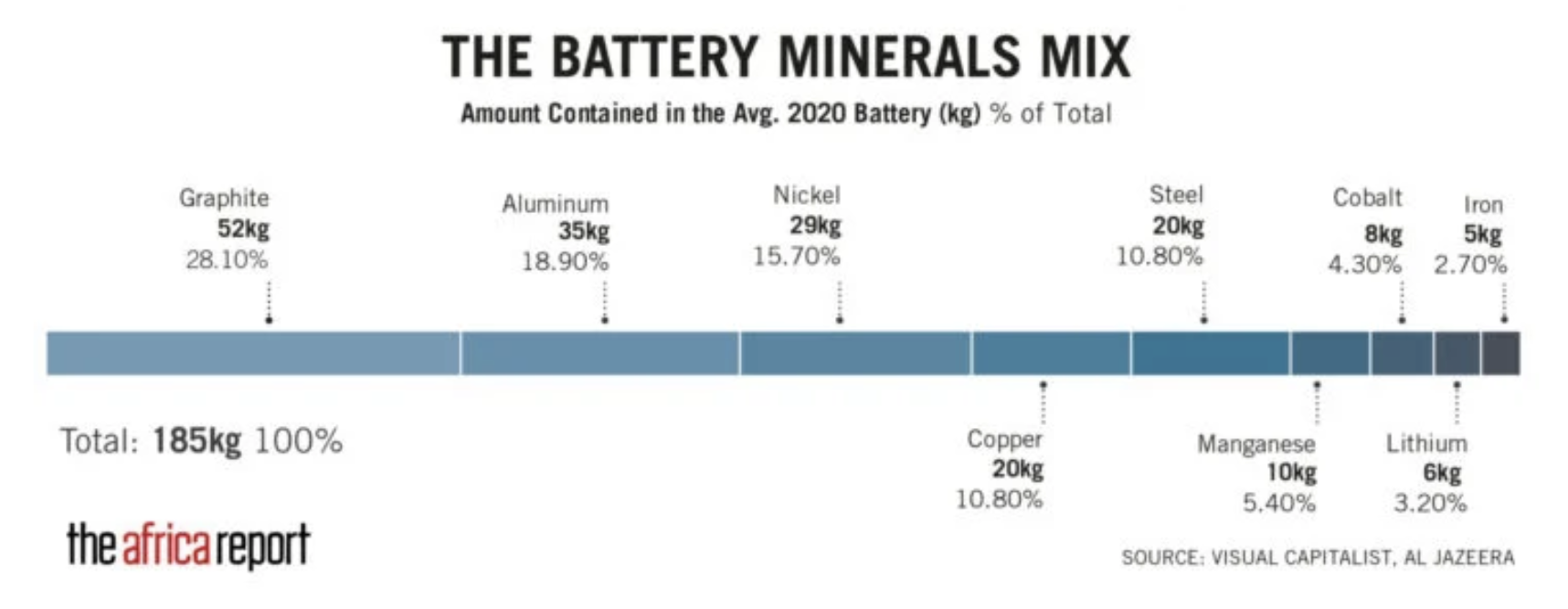
The surging global demand for batteries that power everything from EVs to smartphones and laptops has sparked a global scramble for elements such as lithium, nickel, cobalt, manganese and graphite. Meanwhile, solar panels require plenty of copper, silicon, silver and zinc, while wind turbines rely on iron ore, copper and aluminium.
“As we see shiny car after shiny car being launched … well, what’s in that car?” US President Joe Biden’s Coordinator for International Energy Affairs Amos Hochstein told this year’s Mining Indaba in South Africa. “At the end of the day, the car is a tin box with a battery. And what’s in the battery? What’s in the battery is Africa.”
While needs vary greatly, the report concluded that the energy sector’s overall reliance on critical minerals could increase by a factor of six by 2040. Some elements can expect much faster growth in demand: 42 times for lithium, for example, and 20-25 times for graphite, cobalt and nickel.
“Today, the data shows a looming mismatch between the world’s strengthened climate ambitions and the availability of critical minerals that are essential to realising those ambitions,” IEA Executive Director Fatih Birol said upon the report’s release. “The challenges are not insurmountable, but governments must give clear signals about how they plan to turn their climate pledges into action. By acting now and acting together, they can significantly reduce the risks of price volatility and supply disruptions.”
Fertile ground
Many of those minerals can be found in Africa.According to the United Nations, the continent is home to 30% of the world’s mineral reserves, with a particular abundance of the natural resources needed to power the green energy revolution. In 2019, Africa produced almost 1 billion metric tn of minerals worth more than $400bn.
True to its former colonial name of Gold Coast, Ghana remains the world’s sixth-largest producer of gold, a highly conductive metal ideal for use in EV batteries. Meanwhile, the DRC accounts for almost two-thirds of the annual production of cobalt, as well as half – along with neighbouring Rwanda – of the world’s tantalum, a silvery metal used in circuit boards for cars, computers and mobile phones.
And with rising US-Chinese tensions sparking a worldwide race to diversify supply chains, previously overlooked African deposits are also getting a new look. That’s the case for lithium, with DRC, Mali and Zimbabwe hoping to become the next big global supplier of the “white gold” for electric vehicles.
As global players place their bets, the next few years present a “moment of opportunity” for Africa, Hochstein said in South Africa.
“We are at a moment of the greatest transformation that we’ve seen since the industrial revolution,” he said. “We are entirely recreating the energy system. And we are taking a 150-year-old system and we’re unplugging it while plugging in a new one. And that is remarkably complicated and difficult.”
Gold rush
However, this new revolution comes at a time of renewed great power competition that Africa has no desire to get sucked back into.The West’s vision of an international liberal order that prevailed after the end of the Cold War has given way to intensifying global rivalries in recent years, particularly between the US and China. Suddenly, the US finds itself in a panic over Chinese dominance over global mineral processing. According to the IEA, it includes as much as 90% of rare earths metals, 50% to 70% of lithium and cobalt, and 40% of copper.
“The African continent is the cradle of Chinese Communist Party economic colonisation and military dominance,” the new chairman of the congressional panel on Africa, Republican John James of Michigan, said upon taking over last month, citing in particular “the human rights abuses in the critical mineral mining industry.”
While China stands accused of cutting questionable deals with corrupt politicians, Russia’s abuses in the mining sector are more clear-cut. The Wagner Group of Kremlin-linked mercenaries in particular is widely reported to be making bank on its African interventions by bleeding dry the Ndassima gold mine in the Central African Republic while exploiting various other mining concessions in Mali, Sudan and Burkina Faso.
The US government has responded with a flurry of initiatives, from the Biden administration’s new Africa strategy to last year’s Inflation Reduction Act, that encourage the diversification of the global supply chain for strategic minerals.
“The US will assist African countries to more transparently leverage their natural resources, including energy resources and critical minerals, for sustainable development while helping to strengthen supply chains that are diverse, open, and predictable,” the strategy reads.
Courting Africa
Both the US and China are rolling out inducements.In Zimbabwe, Chinese investors last year signed a deal with President Emmerson Mnangagwa to build a $2.8bn battery metals industrial park whose lithium, platinum and nickel resources will be used to make solar batteries. At the same time, American agencies such as the US International Development Finance Corporation (DFC) are weighing their own investments.
“A lot of countries in sub-Saharan Africa have a wealth of these critical minerals,” says Vibhuti Jain, the DFC’s regional managing director for Africa. “We have a fairly robust pipeline of opportunities that we are currently evaluating in a number of different countries and relating to a number of different minerals that will be instrumental to the green economy.”
The DRC is ground zero in this new resource race.
Neighbouring Rwanda, Uganda and Burundi have all been scrutinised for allegedly backing various armed groups in the eastern Congo to get their hands on the region’s riches. The Biden administration is keen to help President Felix Tshisekedi revisit the terms of infrastructure-for-minerals deals struck with Chinese miners under his predecessor, Joseph Kabila.
At stake is nothing short of “avoiding the risk of any single country or entity dominating the global supply chain,” says J. Peter Pham, a former US special envoy for the Great Lakes region under President Donald Trump who is unofficially advising both the US and Congolese governments pro bono.
“A lot of people have an antiquated view of the world,” Pham says. “It’s not about who digs up the minerals. It’s about how the processing occurs.”
“The challenge to the world is a near-monopoly that China has on processing. Now it starts with their digging this stuff up, obviously. But in a way, as long as it meets labour and environmental standards, I’m less concerned about who does the digging and I’m more concerned about where it goes afterwards, and who captures the value chain.”
China, Russia and the US are not alone.
A lot of countries in sub-Saharan Africa have a wealth of these critical minerals.
Saudi Arabia for example announced in January at its Future Minerals Forum that the country’s sovereign wealth fund and state mining company Ma’aden were launching a new mining fund aimed at “securing value chains critical to industrial development and energy transition in the Kingdom.” The fund aims to invest up to $15bn to secure minerals including copper, nickel and lithium for domestic processing, reports the Financial Times.
Value proposition
Africa however is less and less interested in simply selling off its resources.From slave labour to cocoa beans to fossil fuels, Africa has long provided for a pittance the resources that have built vast fortunes across Europe, Asia and the Americas.
With the minerals of the future, today’s business and political elites are keen to avoid history repeating itself. Across the continent, African leaders are declaring that the era of foreigners simply extracting resources while adding all the value elsewhere is over.
Elon Musk, the South African-born owner of the world’s best-selling EV brand, found this out the hard way last year when Nigeria rejected his bid to tap the country’s lithium reserves unless Tesla builds a battery-making factory in the West African nation.
“The Nigeria Mineral Value Chain Regulation aims to end the export of crude mineral ores from Nigeria and thus demands that miners add some value,” mining ministry official Ayodeji Adeyemi made clear at the time. “As for lithium, it doesn’t necessarily mean investors must produce batteries here before they can mine, but some form of industrial processing of the ore is required.”
Other countries are beginning to follow suit, even as getting investors interested in refining and processing Africa’s resources on the continent remains a tough proposition.
Of the slew of lithium mining projects announced across Africa, all but one currently plan to send the raw mineral to other parts of the world for processing, according to Jeune Afrique. The sole exception is the Manono open-pit mine in the DRC – possibly the world’s largest lithium deposit – which is in limbo amid an ownership dispute between Australian miner AVZ Minerals and China’s Zijin Mining.
Developed nations interested in scooping up Africa’s minerals are at least paying lip service to the need for change.
“We aim to make sure minerals-rich countries benefit from all stages of the value chain, from extraction to processing to recycling,” US Secretary of State Antony Blinken said at a gathering of the new Minerals Security Partnership between resource-hungry countries and African nations on the margins of last September’s UN General Assembly in New York that was attended by envoys from the DRC, Mozambique, Namibia, Tanzania and Zambia. “That’s ultimately how we can make sure each project actually serves your communities and uplifts your citizens.”
The Biden administration followed up in December at the US-Africa Leaders Summit with the signing of a first-of-its-kind memorandum of understanding pledging to support the DRC and Zambia as they jointly develop a supply chain for electric vehicle batteries. The MOU notably promises “increased awareness of investment opportunities” and the identification of “potential co-financing opportunities.”
Clean up on aisle mine
International interest however will continue to lag so long as the African mining sector continues to suffer from a reputation for corruption, unpredictability and worker abuse.Wall Street has raised billions upon billions of dollars for electric vehicles and batteries, says John Dowd, CEO of GoGreen Investments, which is working with clean battery metals developer Lifezone Metals to develop one of the world’s largest and highest-grade undeveloped nickel sulphide deposits in northwest Tanzania. And yet investment by the mining industry is still about 30% below its peak, Dowd points out.
The reason is simple.
“While everybody is bullish on batteries, everybody loves batteries, most people hate mining,” Dowd told The Africa Report during a recent stop by Washington to brief US policymakers about the Kabanga project. “And that’s the rub. Because batteries are made out of things that you mine.”
The industry, Dowd says, has a “history of exploitation” and therefore a unique responsibility.
“It is a fascinating challenge, where on one hand, you have these aspirations of cleaning up the world with electric vehicles, and on the other hand, to do that, fundamentally, we need to clean up – not just from an environmental point of view, but from a social point of view – the entire mining industry.”
Governments across the continent are also taking action, with countries from Angola to Zambia touting investor-friendly changes to draw in foreign capital. In January, South Africa celebrated the first fatality-free month in the history of its mining industry (49 miners died in 2022, a record year for safety).
Reforms remain a work in progress, however, with lingering issues with mining licence expropriations in Tanzania taking some of the sheen off President Samia Suluhu Hassan’s pro-business credentials.
Some leaders from well-run countries are sounding words of caution.
“When there is a rush, people come in, take whatever they want to take, and go, leaving gaping holes in Africa,” Botswana Minister of Minerals and Energy Lefoko Moagi told Reuters on the margins of the Mining Indaba.
Africa’s largest producer of diamonds is reviewing its minerals legislation to “tighten up” laws on mine rehabilitation, he told the wire service.
“If you want to push production because there is money that is being dangled, you start compromising on how you legislate, how you do your environmental permitting, how you consult your communities,” Moagi said. “There is a great danger there that Africa must watch out for.”
Conflicting priorities
The US and European powers see an opening to outcompete China by placing a premium on social responsibility.For the past year, the Biden administration has been promoting the idea of a “race to the top” in the quest for minerals. At the Mining Indaba in South Africa, the Minerals Security Partnership followed up with the release of a set of “principles for responsible critical mineral supply chains.”
“It is imperative that mines, processing, and recycling facilities be developed in a way that protects the environment, promotes good governance, and provides economic benefit to local workers and communities,” the standards insist.
“Adherence to such principles is necessary to advance a clean energy transition while ensuring minerals-rich countries and affected communities are able to fully participate in and benefit from this generational opportunity.”
Days earlier on 26 January, the State Department announced a $900,000 funding opportunity for organisations interested in cleaning up mining and other sectors in Africa.
“Human rights abuses are alleged in the mining, manufacturing, and construction sectors across Sub-Saharan Africa,” the notice says. “Concerns about these often foreign-owned and operated industries include lack of transparency and disclosure of impact assessments and due diligence processes, land rights violations, loss of livelihoods, health threats, and labour rights abuses.”
While it’s not the first such funding opportunity, a State Department spokesperson told The Africa Report that “worker rights are absolutely a global priority for the Biden-Harris administration.” The spokesperson said the administration “brought labour leaders together with government officials to discuss this very issue on day one of the US-Africa Leaders Summit, concluding that elevating the worker’s voice is critical to building a prosperous Africa based on inclusive growth and sustainable development.”
This focus on “clean” minerals is causing trade frictions between the US and its allies, with the European Union (EU) and Japan upset at new US subsidies for electric vehicles that require battery minerals to be sourced domestically or from countries with which the US has a free-trade agreement. Following the blowback, Washington is now hammering out a deal to focus instead on meeting environmental and labour standards for sourcing critical minerals.
“We will deepen our cooperation on diversifying critical mineral and battery supply chains, recognising the substantial opportunities on both sides of the Atlantic to build out these supply chains in a strong, secure, and resilient manner,” President Biden and European Commission President Ursula von der Leyen said in a 10 March joint statement following her visit to the White House. “To that end, we intend to begin negotiations on a targeted critical minerals agreement.”
Slew of restrictions
Some critics however say US companies are already hamstrung by a slew of restrictions, including the 1977 anti-bribery Foreign Corrupt Practices Act, the 2008 Child Soldier Protection Act and the 2010 Dodd-Frank Act, which requires companies to disclose their use of so-called “conflict minerals” – tin, tungsten, tantalum and gold – from DRC and neighbouring countries. They say increasing the regulatory burden will only put US, would-be miners, further behind their Chinese competitors.“There’s nothing happening right now, despite unfathomable sums of money being spent by our government and other governments [for] critical minerals, rare earth projects and things like that,” says a US-based advisor to global mining firms who asked to remain anonymous to freely criticise US policy.
“We basically say US industry can’t do business in these places,” the advisor says. “So it’s just not even worth their time. Yet Canadian companies are all over the Congo. And obviously, the Chinese. It’s our own regulatory burden that prevents and deters US companies, specifically in mining, from even going to Africa.”
Hochstein summed up the challenge at the South Africa mining conference.
“The world once again finds itself relying on and critically needing the resources that are abundant in Africa,” he said.
“Will Africa rise to that challenge? Will countries on the continent say this is our moment, to not only be suppliers to the world but the moment [to capture] that wealth [and] transform countries and the continent as a whole, to build new infrastructure and new schools and new hospitals?”

Focusing primarily on The New Seven Sisters - the largely state owned petroleum companies from the emerging world that have become key players in the oil & gas industry as identified by Carola Hoyos, Chief Energy Correspondent for The Financial Times - but spanning other nascent opportunities around the globe that may hold potential in the years ahead, Wildcats & Black Sheep is a place for the adventurous to contemplate & evaluate the emerging markets of tomorrow.