
June 25th, 2023
Via World Economic Forum, a report on the immense economic potential of women entrepreneurs in emerging markets:
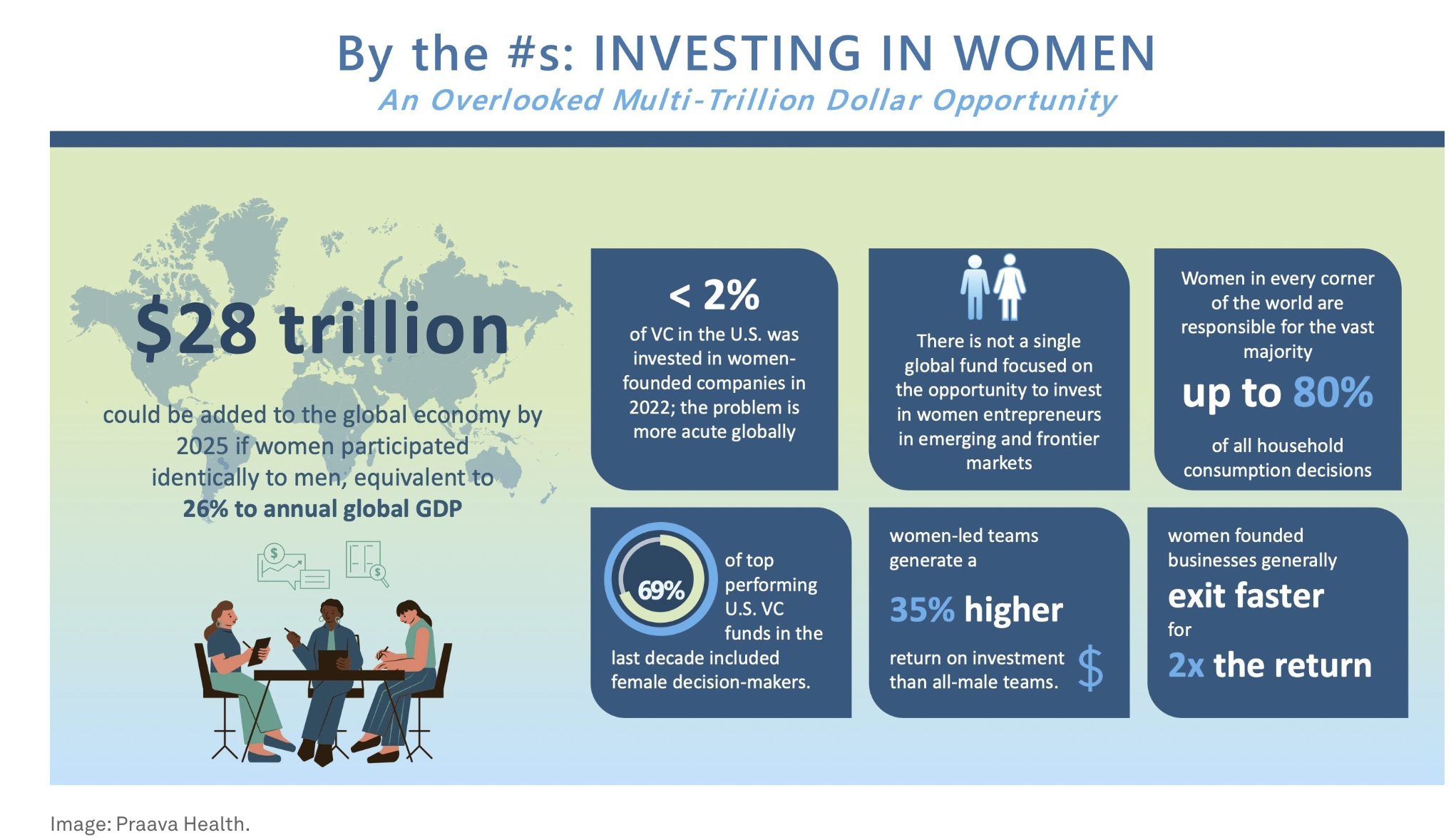
> Globally, women could add as much as $28 trillion, or 26% of global GDP, by 2025.
> In emerging markets, women-owned and led companies are systematically overlooked and under-financed.
> A strong business case exists for investing in these entrepreneurs which are generating attractive economic, social, and environmental returns.
The McKinsey Global Institute (MGI) estimates that if women participated in the economy “identically to men”, they could add as much as $28 trillion or 26% to annual global GDP by 2025 – an amount greater than the size of the US economy today. Yet even in the US, where venture capital (VC) is more sophisticated than anywhere else in the world, less than 2% of VC was invested in women-founded companies in 2022 – the lowest level seen since 2016 and 2012. In Europe, the percentage is even lower, at less than 1% in 2022.
Women are also underrepresented as investors – in the US, women make up less than 20% of early-stage investors. The disparity is even worse in emerging markets. We have seen this firsthand as investors and leaders of an emerging market start-up and a women-led consultancy working with high performing women-led businesses globally.
Outperformance
Data demonstrates that women-led businesses outperform the market. For instance:
> A Catalyst study found that companies with a higher proportion of women in top management positions had a 34% higher return on equity and 42% higher return on invested capital than companies with the lowest proportion of women in top management positions.
> First Round Capital reported that female-led companies performed 63% better than all-male founding teams and women-led teams generated a 35% higher return on investment than all-male teams.
> In terms of how effectively companies turn a dollar of investment into a dollar of revenue, startups founded and co-founded by women are significantly better financial investments. A BCG report found that for every dollar of funding, female-founded startups generated 78 cents, while male-founded startups generated just 31 cents. Women founders also outperformed their male counterparts despite raising less money.
> According to Pitchbook, women founded businesses generally exit faster for double the return.
> Of the top-quartile-scoring US VC funds in the last decade, 69.2% included female decision-makers.
There’s yet another reason female founders are smart investment decisions. It’s well accepted that women around the world are responsible for the vast majority – up to 80% – of consumption decisions; 14 years ago in 2009, Harvard Business Review noted that “women now drive the world economy.” In emerging economies, where 85% of the global population lives and where economic growth is fuelling a global middle class that’s growing by the hundreds of millions every year, consumer demand is growing across all segments, including healthcare, education, real estate, agriculture, energy, tech, and fashion. Women-led businesses have firsthand insights on how to serve the changing needs of these consumers.
Signs of progress
The volume of funds launched with a gender-lens investment commitment has grown by 250% since 2017, according to a survey conducted by the Wharton Social Impact Initiative, but these funds still face significant challenges with fundraising. Only about 40% of the targeted funds had successfully raised capital at the time of the survey in 2021.In the US and Europe, there are a few investment funds focused on female-led businesses and supporting women founders, but in the rest of the world they are practically non-existent. Women-owned and led companies in developing and emerging economies are systematically overlooked, under-valued and under-financed, across all asset classes. Except for a few allocations that are focused on extending microfinance to small businesses in emerging and frontier markets, there is not a single global investment fund – not even within development finance institutions – focused on this opportunity.
This is a massive missed financial opportunity. Emerging markets represent the largest contributors to global growth. PricewaterhouseCoopers, for example, projects that by 2050 six of the seven largest economies in the world will be countries that are currently considered emerging markets. Standard Chartered Bank has drawn attention to the opportunity for private investors to shift investment strategies from developed to emerging markets, demonstrating the potential to boost emerging market household consumption by 4.5% annually and GDP by 3.1% annually for every year through 2060.
What’s needed now
The evidence is clear: investing in women-owned and led businesses in these markets represents a triple-bottom-line opportunity. To unlock it, women-led businesses in emerging economies require capital at all stages of launch and growth. A 2021 Citibank survey of women entrepreneurs in low- and middle-income countries found that 36% of women cited access to finance as their main challenge. Only 16% of respondents had secured an investment or loan from a bank and just 6% had accessed a business loan.Women entrepreneurs in frontier markets need investment most at two key stages. First, is the “missing middle”: businesses established through traditional microfinance mechanisms that need financing from around $50,000 – $2 million to scale up. The International Finance Corporation estimates a $300 billion gap in financing for this segment, with more than 70% of women-owned SMEs having inadequate or no access to financial services.
The second key stage of growth is companies looking for venture funding from seed stage through series D, but especially series A-D. The IFC estimates that only 7% of total private equity and venture funding in emerging markets is focused on women-led businesses. A few other notable examples: in Latin America, Crunchbase reported that not one dollar of the $4.4 billion that went to start-ups in 2020 went to women-founded companies without a male partner; the Africa Gender Innovation Lab reported that only 3% of venture funding in Africa went to all-women teams. (Notably, this is higher than the percentage of VC currently going to women-led businesses in the US.)
Looking ahead
Imagine a world where women have access to more capital to create and scale solutions to massive global problems, a world where women are founding billion dollar businesses all over the globe, a world where we can harness our power and build wealth to contribute to a better world.This is not about inclusion for the sake of equity, or because it “feels good,” or because it is an environmental, social, and governance (ESG) check-the-box activity. This is a call to action: invest in women – the true multi-trillion dollar opportunity.
Focusing primarily on The New Seven Sisters - the largely state owned petroleum companies from the emerging world that have become key players in the oil & gas industry as identified by Carola Hoyos, Chief Energy Correspondent for The Financial Times - but spanning other nascent opportunities around the globe that may hold potential in the years ahead, Wildcats & Black Sheep is a place for the adventurous to contemplate & evaluate the emerging markets of tomorrow.